
Translatology
The field of language and culture mediation refers to the facilitation of communication across different linguistic and cultural settings. It is a wide-ranging field that takes in translation, interpreting, and localisation, as well as accessibility, inclusion and more. Language and culture mediation permeates everyday life, whether in the form of synchronised or subtitled film screenings, multilingual court hearings, or as knowledge transfer between professionals and non-specialists.
The study of language and culture mediation is also known as Translatology. Although recently established as a modern scientific discipline, it is anchored in a long tradition of education and research, with historical roots reaching far back into the past. As a science of mediation, it examines communication practices across different communicative contexts.
Far beyond language proficiency
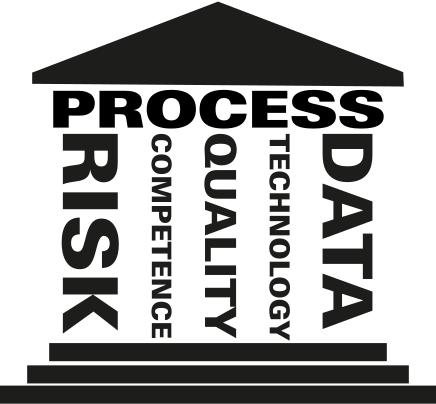
Professional language and culture mediation encompasses far more than mere proficiency in two languages. It often involves critical or high-risk factors, particularly within specialised fields such as law, medicine, or technology. Moreover, even when supported by digital tools, language and culture mediation inevitably affects people, whose rights and interests must be upheld within the profession’s ethical framework. This is why degree and professional training programmes are based on elaborated competency models and guided by established standards and norms.
Active agents of digitisation
Machine translation is not a recent phenomenon. In fact, the idea of a translation algorithm can be traced as far back as the 9th century. However, it was not until the 20th century that technical attempts to realise this idea emerged. The 1990s eventually marked the onset of a broad digital transformation in the work environment of language and culture mediators. Today, professional mediators are equipped with a wide range of digital tools and resources. As a result, the field has gained valuable experience in navigating the opportunities, risks, and limitations of digital technologies. With this expertise, language and culture mediators play a decisive role in shaping the digital transformation of multilingual and intercultural practices.