Schlagwort: englisch

  • Transfer workshop at TT2026

    Transfer workshop at TT2026

    IfTra will host a workshop focused on transfer activities and projects at the Translation in Transition 2026 conference at RWTH Aachen. On the afternoon of September 9th, we will first gather three presentations on transfer activities, informing on the Translate Science Initiative, a project on developing inclusivity-friendly prompting guidelines and current transfer activities in audiovisual translation at AppTek (see below for details).

    The series of presentations will be followed by a roundtable on the relevance of transfer for research and practice in translation and interpreting. The presenters will be joined by Prof. Dr. Silvia Hansen-Schirra who heads the Competence Center for Translation and Communication at the University of Mainz in Germersheim.

    Workshop programme

    Wednesday, September 9th, 2pm-3:30pm (14:00-15:30)

    Oliver Czulo, Daniel W Chan & Jennifer MillerThe Translate Science Initiative
    Vasiliki ChelidoniBest Practices for Inclusivity-Friendly Prompt Engineering
    in Multilingual AI-powered Translation
    Evgeny MatusovProfessional and automatic post-editing in the context of
    subtitle translation: practical experience, challenges,
    solutions

    Wednesday, September 9th, 4pm-5pm (16:00-17:00)

    Roundtable „Relevance of transfer for translation and interpreting research and practice“
    – Oliver Czulo, Institut für Translatologie gGmbH
    – Vasiliki Chelidoni, Ionian University
    – Evgeny Matusov, AppTek
    – Sivlia Hansen Schirra, University of Mainz in Germersheim
  • Online talk „Translating research software“

    Online talk „Translating research software“

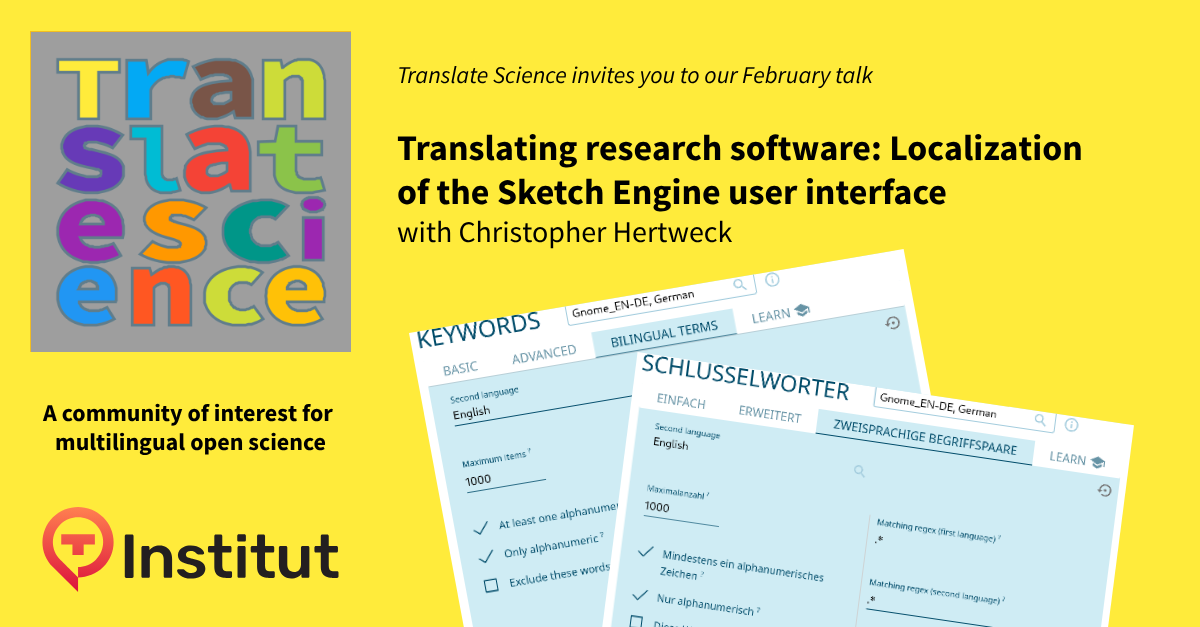
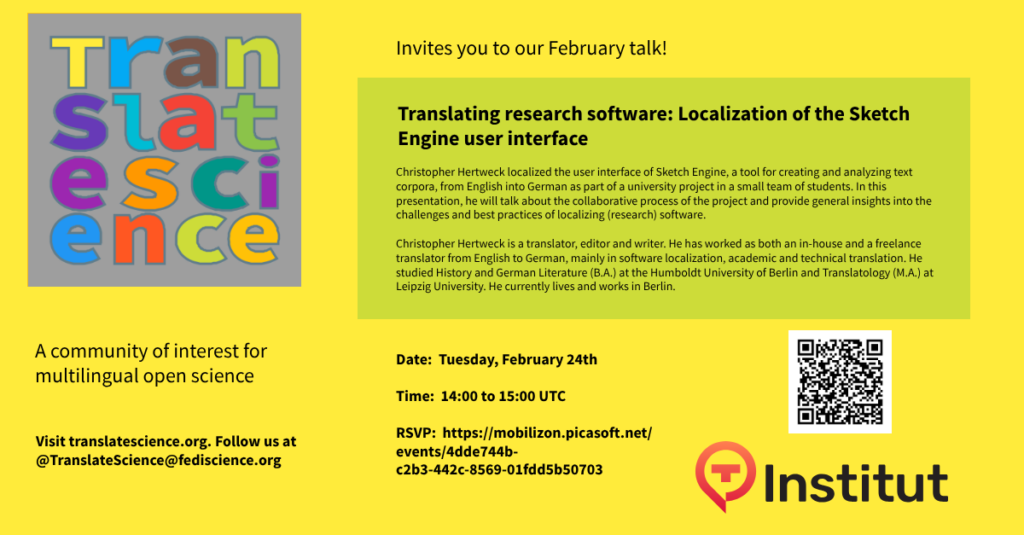
    The Institut für Translatologie gGmbH cooperates with the Translate Science initiative to host a talk about the challenges and best practices of localizing (research) software. Our guest Christopher Hertweck localized the user interface of Sketch Engine, a tool for creating and analyzing text corpora, from English into German as part of an internship project with a small team of students. In his presentation, he will talk about the collaborative process of this project and privde general insights into the challenges and best practices of localising (research) software.

    Christopher Hertweck is a translator, editor and writer. He has worked as both an in-house and a freelance translator from English to German, mainly in software localization, academic and technical translation. He studied History and German Literature (B.A.) at the Humboldt University of Berlin and Translatology (M.A.) at Leipzig University. He currently lives and works in Berlin.

    Learn more about the presentation and how to register under https://transci.hypotheses.org/219885.

  • MuLingFrames: a data format for multilingual framenets

    MuLingFrames: a data format for multilingual framenets

    From January to September 2026, the Institut für Translatologie gGmbH will run a cooperation project within the National Data Infrastructure consortium Text+, in collaboration with LinguisticBits. The goal of the project is to define a TEI-conform data format for multilingual projects. Two existing multilingual framenets, the lexicon of soccer jargon Kicktionary and the resource G-FOL for English-native learners of German, will be converted into this format.

    Framenets are culture-sensitive concept databases. They describe knowledge structures (so-called frames) as well as linguistic forms that are connected to them. For instance, the G-FOL contains a frame entry Thinking: Opinion which illustrates that this knowledge structure represents a Thinking being that has an Opinion on a specific Topic which it holds to a certain Degree. The entry lists English and German linguistic forms such as verbs, nouns or sentence patterns by means of which we can express an opinion or the degree to which we hold it.

    Framenets currently exist mainly in single languages. however, multilingual framenets and applications are becoming increasingly relevant, for instance, in order to create language learning resources, to assess the similarity of multilingual image descriptions or evaluate machine translation systems. The missing of a standard-conforming template for a data format has been a technical challenge for multilingual framenets to this date. The base format defined in the MuLingFrames project will alleviate this challenge. The project outcomes will be published under a non-commercial licence under completion.